Tuesday, March 2, 2010

Wolfgang Iser on Art
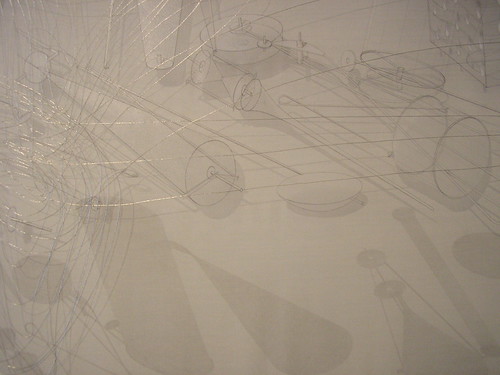
(Bernard Moninot, Dessin sur soie n° 2 [sans titre], acrylic, graphite, and silver thread on canvas.
Dole Municipal Museum of Fine Arts, Dole, France, April 2007)

Right from the start this contradiction [between the supposed transcendence of art and the revelation thereby that art did indeed have a function and was therefore dependent on worldly reality] was aggravated by the need to provide a concrete idea of what autonomous Art meant. The mere impulse of abstracting Art from the given world was not enough to convey an image of its autonomy. After all, Art was claiming to be the realm of freedom in which lay man's only chance to ennoble himself; but if man was to be led to true humanity by way of Art, then this Art that was to underlie his education could scarcely remain an abstract idea. How, though, can one concretize something that only lives through the transcendence of its direct opposite?

The answer was: by collecting all the great artistic achievements of the past. Hence the emergence of that typically nineteenth century institution, the museum. Originally, collections had grown from the personal tastes of individuals; but now the multiplicity of tastes had to be unified into a single concept of taste which could take on normative authority. And so works of art were taken out of their sacred or profane settings and placed in the museum. It is this 'abstraction,' this uprooting of the work from its context, that underlies whatever we have now come to call a work of art. As a representative of a normative taste, it must exercise its effectiveness entirely through itself, and not through any purposes of functions. It is scarcely surprising that when Duchamp displayed a bottle rack in a museum, everyone was shocked. For the museum was the final triumph of autonomous Art, in that it took works of art out of their historical settings and endowed art of all periods with contemporaneity, so that from their various appearances there could be extrapolated a single, universally valid norm of Art.

Once again, however, there is no escaping the problem that the museum was in fact meant to dispose of. The museum is 'a late stage of all the successful representations in the history of art, which are preserved by a present that simultaneously distances itself from them, in order to enjoy its own uniqueness' [quoting Blumenberg, Arbeit am Mythos,p 382]. This enjoyment, however, brings to light precisely the factor that the unified collection of works sought to cover up--namely, the historical relativity of taste, as evinced by the individual works and also by the historical functions, sacred or profane, that they had to fulfill in their original settings. Thus, the contemporaneity with which the museum endows the works actually causes stress to be laid on their historical differences, the concealment of which was supposed to underpin the claim of Art to be autonomous.

From Prospecting: From Reader Response to Literary Anthropology, Johns Hopkins UP 1989, pp 204-205.

Labels: , , ,

Sunday, February 21, 2010

return to the archive

after some changes

Wow, it's been a long time since I wrote about Derrida. Well, let's change that. I'm re-reading The Postcard for the chapter I'm writing right now and it makes me remember exactly why I love Derrida. He is so materially romantic. The archive? Yes, it's the part of memory work that contains the trace of the past, and it's an important theoretical trope. But it's also a material love story for Derrida, who caresses his distant beloved via his careful treatment of the things around himself. He notices everything. The book is full of trains, photomatons, houses of cards, pots of growing myrtle, books, letters, postcards, photographs, traces of the beloved and the disappearance. And throughout it there is the insistence on the burning of the archive--let's destroy it as we go, let's start over, Derrida (or 'Derrida', because as readers we're not meant to be sure of who we are reading, I don't think) says. Let's build this record of all the things that I love and you love and then if we need to let's leave it all behind, poems and libraries and Purim cakes and telephones and hands and cut-paper flowers.

Labels: , , , , , , , , , , ,

Tuesday, February 16, 2010

"...but he did have pictures of this apartment. He got the job."

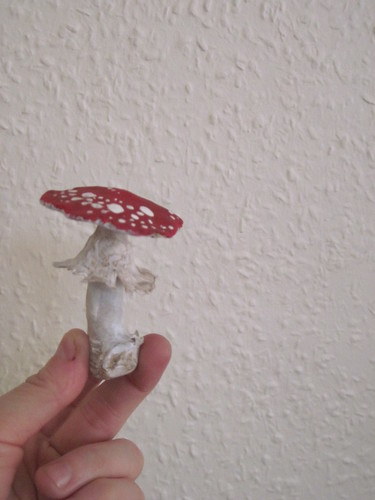
amanita

It's the last sentence of this article* that I think speaks most to me--about how our 'training' as thinkers, makers, and academics has to be flexible, and not only nominally so. It's time for a re-valuing of diverse and deep knowledges, and of unorthodox expressions thereof! Why not--why can't a maker be a geographer, or a pattern designer, or an amateur (in the best sense of that word) astronomer? Especially with the amount of information that is available to us now via the internet (not to mention via the more traditional sources--public libraries, museums, universities, etc.), there is so much possibility for deepening and broadening our understandings.

It wasn't so long ago that an apprenticeship--proving one's capabilities, learning by doing--was an acceptable way to learn things. Why not now? Come on, all you auto-didacts: there's a whole lot of everything out there waiting to be known and thought about and wondered at and questioned. And that can change the system as we know it--where at the moment more and more it seems that education is 'just' a means to an end; where things like 'impact' (what does that even mean?!) mean more than passion and wonder; where learning is commodified and curiosity loses ground.

Education in the most open sense of the word--open access to and curiosity about the world, or as much of it as possible--should be for everyone. And it begins in thinking that things are possible, that one can learn about what is interesting.

So what would you do? What do you want to know? Where are you going to begin?

---

* N.B.: I do find the kind of blithe endorsement of collecting for the sake of the aesthetic of collections kind of bizarre, though. What's the point of having Wellies you don't wear? Okay, they're beautiful objects, designed objects...but they're also functional. Design for design's sake? I think W. Benjamin would have something to say to that.

Labels: , , , , ,

Wednesday, January 27, 2010

on saturday

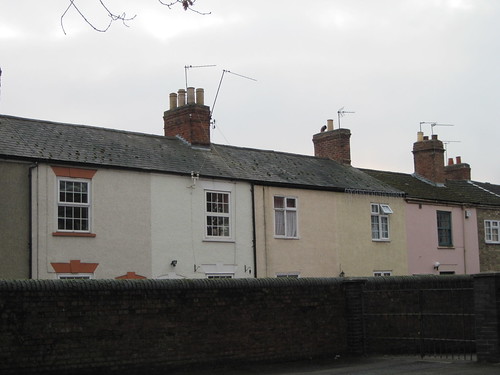
sherbet-colored houses

We went to Rugby (the town, not the sport, although that's where we get rugby). Fran thought I meant rugby when I meant Rugby so she was surprised about halfway there. Oh, that's why you wore those clothes! Ha. We went to the gallery where my work is and then walked around the town. I had been there before, this summer, to see the Museum of Everyday Life.

Earlier that morning, terrible but joyously noisy breakfast with entire Beeston contingent, charity-shop shopping (where I found a really beautiful blue midcentury ceramic pitcher for £3), and walking in the brief sunshine. I love mornings. And my life.

Best part of the day was telling some (12-year-old) kids who tried to harass us that we were from an (imaginary) republic where there were no cars, and confusing them when they tried to explain (or point cars out) by calling them 'cows'. And our names began with a letter that was unpronounceable in English. And that we'd walked to Rugby--but very quickly, on the motorway, so it only took 20 minutes. Also gleaned the valuable information from said lads that ASDA is indeed Rugby's best candy shop. Out of the mouths of babes, folks.

Labels: , , ,

Sunday, January 10, 2010

I love this.

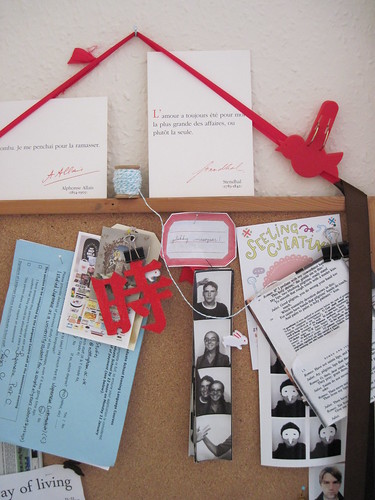
above my desk

"But if you really learn how to pay attention, then you will know there are other options. It will actually be within your power to experience a crowded, hot, slow, consumer-hell type situation as not only meaningful, but sacred, on fire with the same force that made the stars: love, fellowship, the mystical oneness of all things deep down.

"Not that that mystical stuff is necessarily true. The only thing that's capital-T True is that you get to decide how you're going to try to see it.

"The really important kind of freedom involves attention and awareness and discipline, and being able truly to care about other people and to sacrifice for them over and over in myriad petty, unsexy ways every day.

"That is real freedom. That is being educated, and understanding how to think. The alternative is unconsciousness, the default setting, the rat race, the constant gnawing sense of having had, and lost, some infinite thing."

-David Foster Wallace, from this.

Labels: , , ,

Wednesday, December 2, 2009

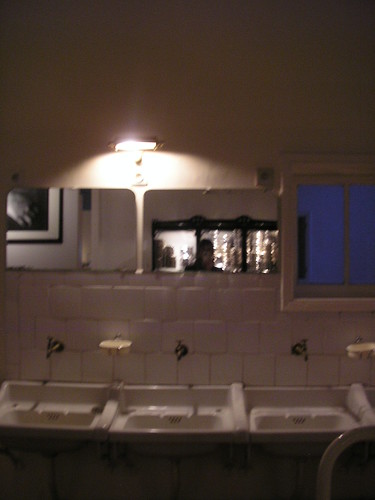
dr. guislain


inmates' sinks

Last time I was in Belgium I spent my Friday afternoon searching for and then walking slowly through the Museum Dr. Guislain. If you are in Gent, take the #1 tram to Guislainstraat; the museum is just around the corner.

Jozef Guislain changed the way psychiatric patients were cared for, and, with the Brothers of Charity, began a new institution for their care. The hospital is now a museum and teaching facility. I think there is still a working psychiatric facility as well.

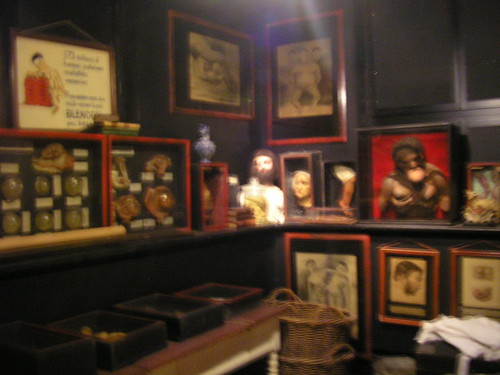
Besides the featured exhibition (while I was there, it was UIT HET GEHEUGEN: over weten en vergeten, or FROM MEMORY: on knowing and forgetting), there was a show of outsider art, a permanent collection of artifacts pertaining to psychiatric care from the 1700s to the present, and (tucked away in a trio of back rooms) a collection of curiosities: wax models of well and diseased bodies; a calf with two faces; babies in formaldehyde; skeletons; a photograph of a baby with two heads; a bearded lady. (I had seen some of this at the Wellcome Collection when I ws there for the Exquisite Bodies show in October, and that's what sparked my interest in the museum.) But while I was actually there I was really struck by the ways that humans have tried throughout the centuries to understand the mind and bring its essential incomprehensibility into some smaller scope...to fit it into the parameters we understand, whether those are chemical or religious or magical.


wax models of bodies and parts of bodies

* * *
And--just a reminder that if you're in Nottingham, you can stop by and see my kiosk today! It's on Pelham Street, across from Homemade Café, just up from Zara. You can see some things I've made here. We're open Tues-Weds-Thurs this week (1-2-3 December) from 10-6 T/W and 10-5 Th.

Labels: , , , , , ,

Tuesday, November 17, 2009

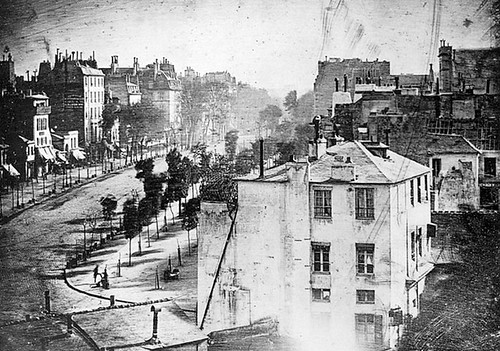
daguerrotype

daguerrotype

The first photograph to contain a human being?

Exposures were so long that movement wasn't captured. But he held still long enough and made it into this century. And surely beyond.

Tomorrow I'm going to Belgium via train. I really like that journey and it will be nice to do work on the way. I'm bringing my (film and digital) cameras. When I get back I expect I will have used up my first roll of film and I'll be able to have it printed and see what the exposures look like. For my birthday, two friends gave me a Kodak camera that's even older than the one I have been using (a Pentax ME) and I want to find film for that and try it out. Maybe very early in the morning, before people are on the street.

I tend to prefer spaces with no people in them.

grove

repetition/pattern


Labels: , , , , , ,

Sunday, November 8, 2009

flax


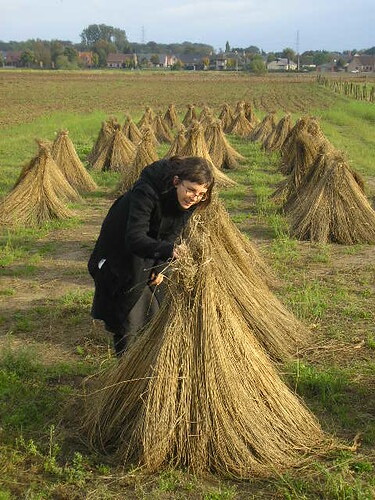
This is the traditional way of preparing flax--it has to rot before it can be used (see retting). We saw these and I wanted to stop and Jonathan said it's pretty rare to see flax this way at all now.

One thing I really like about him is that he always asks me what I think and what I want, but not in such a way that I feel like he's giving up his interests.

* * *

"The question to ask of pictures from the standpoint of poetics is not just what they mean or do, but what they want--what claim they make upon us, and how we are to respond. Obviously, this question also requires us to ask what it is that we want from pictures" (W.J.T. Mitchell, What Do Pictures Want? The lives and loves of images, p. xv).

* * *

No internet at work now; I'm more productive that way. But in recent evenings I've discovered Grijs and Debi VanZyl.

And that's all!


Labels: , , , ,

Wednesday, October 7, 2009

on art and taste


Cy Twombly, Natural History Part 1 (Mushrooms), Tate Modern

"My advice is to go without a guide into the galleries, often; walk along slowly, stopping to look only at those things which interest you. I am sure you will choose the wrong things, probably pictures.... No matter. You like what you like. If they are no good as art you'll tire of them; they will end by making you sick, and you'll choose better things, and better and better, till finally you like the things that are best to you. You may not have perfect taste; there is no perfect taste; but you'll have taste and it will be yours, not somebody else's, but your very own; and you may not be able to lecture on it any better than I can, but you will have a feel for the painter's art, which is a fine art."

From The Autobiography of Lincoln Steffens: Volume I: A Boy on Horseback and Seeing New York First. Harcourt, Brace: 1951. p 130.

Labels: